

Safari experts & storytellers. Since 1991



Nyerere National Park: East Africa's wildest, most untamed safari wilderness
Nyerere National Park at a glance:
Location: Southern Tanzania; Tanzania's southern safari circuit | Access: ~45-min light aircraft flight from Dar es Salaam |
Size: 30,893 km² — largest national park in East Africa | Nearest airport: Julius Nyerere International Airport, Dar es Salaam (DAR) |
Best time to visit: June–October (dry season); peak July–September | Managed by: Tanzania National Parks Authority (TANAPA) |
Safari type: Photographic safaris only; no hunting permitted | Minimum recommended stay: 3–4 nights; 5–7 nights for full immersion |
Why visit Nyerere National Park?
Tanzania has parks everyone knows. Nyerere National Park is not one of them; and that is precisely the point. Formerly known as the Selous, it is East Africa's wildest landscape, where the Rufiji River meets several major tributaries, creating an expansive area where free-ranging wild dogs flourish and authentic wilderness safaris are the norm.
Long overshadowed by the spectacle of Tanzania's northern circuit, Nyerere has always drawn a different kind of traveller: one who prefers solitude to certainty, and depth to convenience. At 30,893 km², it is the largest national park in East Africa, twice the size of the Serengeti, yet it receives a fraction of the visitors. Days pass without another vehicle in sight. Entire lake systems fill at dawn with elephant herds, wading birds and hunting lion prides, and the only sounds are water, wind and wildlife.
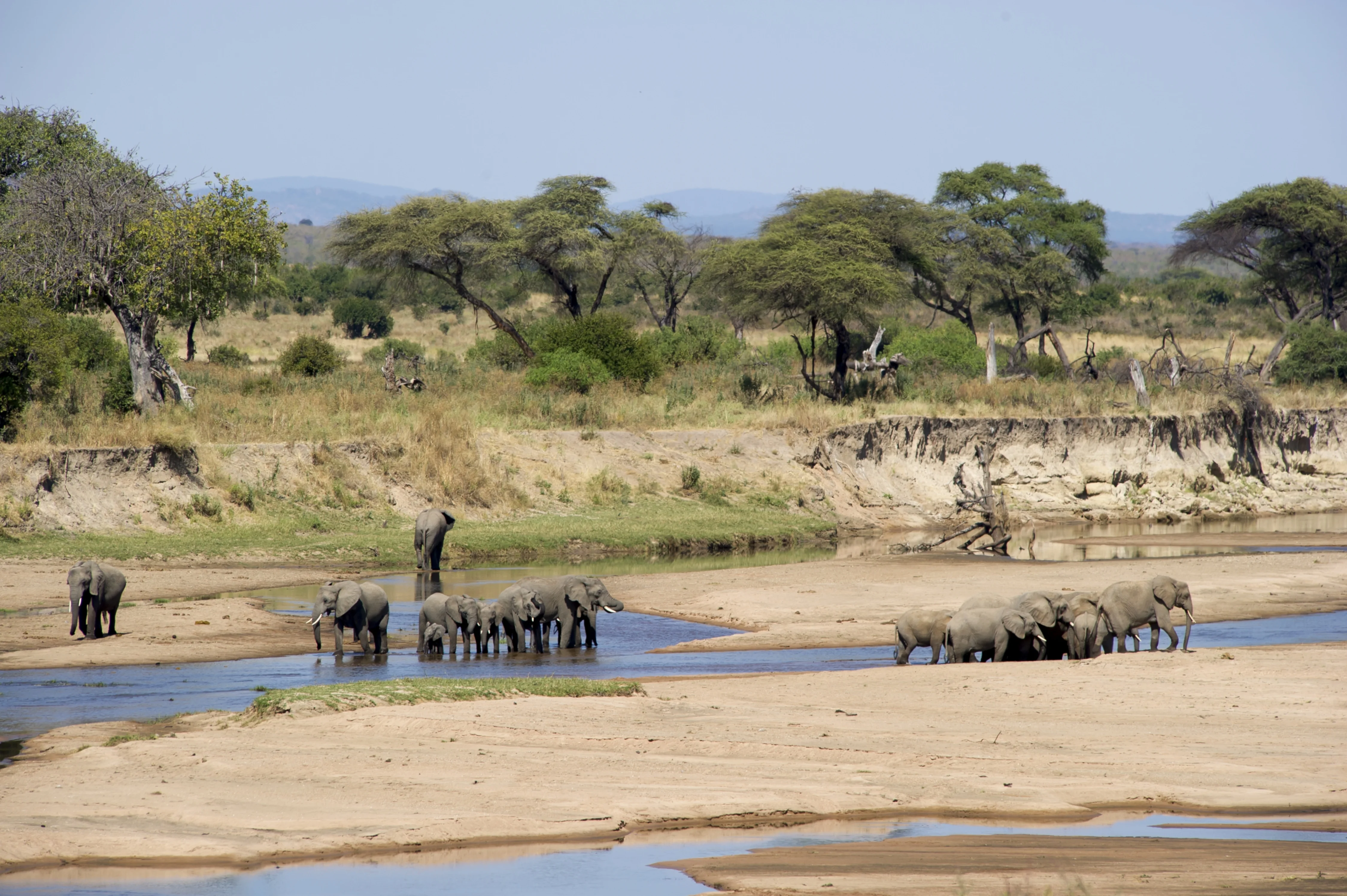
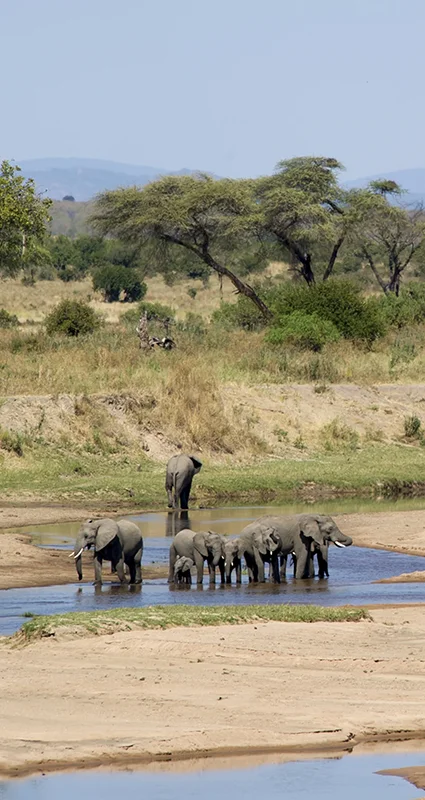
The Rufiji River, Tanzania's greatest waterway, defines everything here. It fills five interconnected lakes that draw dense concentrations of hippos, crocodiles and mammals through the dry season, and it gives Nyerere an activity that no other East African park quite replicates: the boat safari. Drifting past sandbanks thick with enormous crocodiles, beneath mud cliffs alive with carmine bee-eaters, and watching elephants descend to the water's edge is the southern circuit's signature experience, and it cannot be found anywhere in Tanzania's north.
Nyerere also harbours one of the continent's largest African wild dog (painted wolf) populations. Combined with lions, leopards, vast buffalo herds, and one of Africa's most important sable antelope populations, the wildlife experience is compelling by any measure. Add walking safaris, fly-camping and genuine wilderness scale, and Nyerere earns its reputation as the choice of experienced safari travellers who know exactly what they are looking for.
5 Reasons We Love Nyerere National Park
African wild dogs at home: Nyerere holds one of the continent's largest wild dog populations, and watching a pack scatter across open plains is among the most electric sightings in Africa.
Boat safaris on the Rufiji: Few East African parks let you glide by boat past crocodile-thick sandbanks, carmine bee-eater colonies and elephants at the water's edge.
A genuinely trackless wilderness: Over 30,000 km² and almost no crowds, where entire days pass without another vehicle, and the solitude is something northern Tanzania simply cannot offer.
The complete activity menu: Game drives, guided walking safaris, boat trips, fly-camping and night drives - Nyerere delivers the most varied safari activity roster of any park in southern Tanzania.
Permanent, abundant wildlife: Tens of thousands of buffalo, large numbers of predators, zebras, hippos, giraffes, and wildebeest are resident year-round, with no migration calendar needed and no waiting for seasonal spectacle.
All you need to know about Nyerere National Park
Things to do in Nyerere National Park
Game drives along the Rufiji lakes: Off-road driving is permitted here, allowing vehicles to pursue wild dog packs, lion prides and elephant herds across lake shores, open plains and dry riverbeds - including night drive excursions after dark.
Boat safari on the Rufiji River: Drift past crocodile-thick sandbanks, carmine bee-eater colonies on mud cliffs and elephants descending to the water's edge. A safari experience unique to southern Tanzania.
Guided walking safari: Expert armed guides lead walks through miombo and riverine terrain, reading tracks, birdlife and plant ecology at a scale and intimacy no game drive can match.
Fly-camping in the wilderness: Temporary camps set up in open bush, with fire-cooked dinners and a canvas flysheet between you and the African night. Immersive, adventurous and unlike anything in a fixed lodge.
Stiegler's Gorge river excursion: A longer upstream boat journey into the forest-flanked gorge where the Rufiji narrows dramatically, and where the elusive Pel's fishing owl reveals itself.
Selous's Grave at Beho Beho: The resting place of Frederick Courteney Selous, killed by a sniper in 1917 and buried near the Beho Beho River. A quietly moving historical landmark accessible on safari drives.
What wildlife can I see in Nyerere National Park?
African wild dog (painted wolf): Nyerere holds one of Africa's largest wild dog populations. Encounters with hunting packs on open plains are among the park's most celebrated and sought-after sightings.
Lion, leopard and spotted hyena: Lion prides are consistently seen around the lake systems; leopards require patience; hyenas are a reliable and noisy presence throughout the park.
Elephant, buffalo and hippo: Vast herds gather at the Rufiji lakes in dry season. Around 40,000 hippos inhabit the waterways, best experienced at close range from a boat.
Masai giraffe, sable antelope and puku: Giraffe appear on virtually every drive. Sable antelope and puku, in numbers rarely matched elsewhere in Africa, are significant and distinctive sightings.
Nile crocodile: The Rufiji sandbanks hold one of East Africa's largest crocodile concentrations: enormous, unhurried individuals that make every boat safari feel like a journey into deep time.
Almost 480 bird species, including Pel's fishing owl, carmine bee-eater, African skimmer, Böhm’s bee-eater, white-crowned lapwing, palm-nut vulture, rock pratincole, racket-tailed roller, Livingstone’s flycatcher, thick-billed cuckoo, Dickinson’s kestrel, brown-headed parrot, broad-billed roller and collared palm-thrush.
Where to stay in Nyerere National Park?
Two properties define the Nyerere experience for us, and each offers a meaningfully different version.
Sand Rivers Camp sits on a wide bend of the Rufiji River in the park's northern reaches, in a setting safari specialists consistently describe as among the most dramatic in Nyerere. Richard Bonham established the camp in 1984, pioneering walking safaris in the Selous, and that heritage still shapes the guiding culture today. The aesthetic is rustic-chic: whitewashed walls, thatch roofs and open-fronted rooms that trade air conditioning for river breezes and uninterrupted views. Sand Rivers rewards experienced safari travellers, honeymooners and those for whom guiding depth and remote character matter more than polished luxury.
Laba Siwandu Camp takes a very different approach. Set on the shore of Lake Nzerakera in the park's northeastern sector, the camp offers two intimate wings - North and South - each with its own pool, dining room, and lounge. The kitchen leans into a French-influenced culinary tradition, serving plated three-course dinners rather than buffets. Boat safaris on Lake Nzerakera are a signature experience here: the calm lake environment draws waterbirds, hippos and elephants to the shore.
From the Selous to Nyerere: a park's history
To understand Nyerere National Park, it helps to know the Selous: the vast protected area from which it was carved, and whose name still travels widely in the world's safari markets.
The story begins in 1896, when the German colonial governor Hermann von Wissmann first set aside portions of southern Tanzania for protection. By 1905, the area had become a formal hunting reserve. The reserve was named after Frederick Courteney Selous, a British explorer, officer, hunter and conservationist who spent four decades in this wilderness before being killed by a German sniper near the Beho Beho River on 4 January 1917. He is buried where he fell, and his grave remains a quietly moving site accessible on safari today. In the 1940s, the reserve was extended to its present boundaries following the resettlement of remaining communities living within its borders during a sleeping sickness epidemic, and in 1982 the Selous Game Reserve was inscribed as a UNESCO World Heritage Site, recognised for its extraordinary biodiversity and undisturbed natural landscapes.
In 2019, Tanzania's then-president John Magufuli announced that the Selous would be divided. The larger northern and western portions, where photo tourism had always concentrated and where the Rufiji River flows, became Nyerere National Park, named after Tanzania's first president, Julius Nyerere. The eastern section retained the name Selous Game Reserve. The distinction matters: TANAPA manages Nyerere National Park under national park law, with all hunting prohibited and photographic safaris the only permitted form of tourism. The Selous Game Reserve to the east continues to operate as a trophy hunting concession area under the Tanzania Department of Wildlife.
The Selous has faced considerable pressure. The reserve was placed on UNESCO's List of World Heritage in Danger in 2014, largely due to a catastrophic decline in elephant numbers driven by poaching. More recently, the construction of the Stiegler's Gorge Hydropower Dam on the Rufiji River has drawn strong criticism from international conservation organisations concerned about its impact on the river's natural flood cycles and the ecosystems they sustain. These pressures make the case for supporting Nyerere's photographic tourism model all the more urgent.
Travellers searching for a Selous safari are, in most cases, planning a Nyerere safari. The Selous name endures, and it is worth knowing what it now refers to and what it does not.
Trusted by thousands of ecstatic travellers
✔️ 5-Star Trustpilot Rating ✔️ Condé Nast Travel Specialist Award Winner
✔️ Accredited by SATSA ✔️ 5,000+ Exceptional Safaris Since 1991
Why choose Africa Geographic to plan your safari?

"AG made the logistics and experience painless and stress free which is certainly what you want when on holiday. All of the information was on their online portal ( can also be downloaded when cell service not availble). The camps they selected were excellent and matched my needs to a tee. Would certainly highly recommend them to others."
"My first experience planning a safari from overseas and a skeptic by nature, and here I am a week back from one of the best trips of my entire life! It was seemless and perfect from start to finish with no stress, and one of the travelers in our party had a VERY complicated and atypical journey there, and they accomplished it timed perfectly..."
"We asked for a real out of the box experience with no busses and crowds, just a personal touch. It was accomplished. We were there to see the animals no cities and they delivered...The 2 week trip met and exceeded our expectations. We loved being in the bush with experienced guides and no crowds...I would use their services again in the future."
Wish you were here?
Frequently asked questions
Nyerere National Park was created in 2019 from the northern photographic safari sector of the Selous Game Reserve. The Selous name now refers to the adjacent eastern hunting concession area, managed separately. Travellers searching for a Selous safari are, in fact, planning a Nyerere safari.
June to October is the prime season: dry conditions concentrate wildlife around the Rufiji River and its lakes. July to September is peak. Mid-December to January offers good birding and better value. Most camps close April to May during the long rains.
Nyerere is part of Tanzania's southern circuit, quieter, rawer and far less visited than the Serengeti or Ngorongoro. Wildlife is permanent rather than seasonal. Boat safaris, guided walks and fly-camping are available here, and the wild dog population is one of Africa's largest: something northern Tanzania cannot offer.
Yes. Nyerere holds one of Africa's largest African wild dog populations and is one of the continent's most reliable destinations for encounters with this species. Travelling in May or June adds the possibility of seeing pups near their dens. Sightings are never guaranteed but consistently reported.
Nyerere offers game drives with off-road access permitted, boat safaris on the Rufiji River and its lakes, guided walking safaris with armed rangers, fly-camping, fishing and night drives. The Stiegler's Gorge river excursion is a particularly rewarding add-on for those staying on the Rufiji.
Light aircraft from Julius Nyerere International Airport, Dar es Salaam, takes approximately 45 minutes. Coastal Aviation and Auric Air operate scheduled services to multiple airstrips including Kiba, Mtemere and Siwandu. A road transfer from Dar es Salaam is possible but takes five to seven hours.
Three to four nights covers the core experience: game drives, a boat safari and time to feel the scale of the wilderness. Five to seven nights is ideal if fly-camping or deeper exploration appeals. Nyerere pairs naturally with Ruaha National Park, Zanzibar or Mafia Island.
Tanzania's largest river, the Rufiji creates five interconnected lakes at the heart of Nyerere's wildlife-viewing circuit, plunges through the dramatic Stiegler's Gorge and sustains the park's entire ecosystem. Every boat safari and waterside game drive traces back to the Rufiji: it is the pulse of the park.
Yes. Guided walking safaris with expert armed rangers are available from a number of camps and are one of Nyerere's most distinctive experiences. Walk durations range from a few hours to multi-day expeditions. Most camps require a minimum age of 12 for walking activities.
Lion, leopard, elephant and buffalo are all present in meaningful numbers. Black rhino exist in the park but sightings are extremely rare. African wild dogs are not part of the traditional Big 5 but are widely regarded as the park's signature wildlife encounter, and arguably a greater draw.
Most camps close from April through May, when the long rains make roads impassable and flying conditions unreliable. Some properties also close from late March, though opening and closing dates vary by property. The season typically runs from June to mid-March.
Fly-camping involves a temporary overnight camp set up in open bush: basic tents, a campfire and no permanent infrastructure. It is available from certain camps including Sand Rivers. Most properties set a minimum age of 12 for fly-camping participants, making it unsuitable for younger children.
Ruaha National Park is the natural companion: a complementary southern circuit wilderness accessible by light aircraft. Zanzibar or Mafia Island provide an Indian Ocean beach contrast. Mahale Mountains National Park on Lake Tanganyika adds chimpanzee trekking to a broader southern Tanzania itinerary.
Nyerere National Park safaris typically cost from US$665 per person, per night, depending on the accommodation comfort level, time of year and activities. This price usually includes accommodation, all meals, game drives, experienced guides, and 24/7 support from our team.
Click here to schedule a no-obligation call with one of our Safari Experts or fill in our 2-minute form with your questions. Our team of experts are here to help! Whether you’re curious about the best time to travel, want to hear first-hand about an experience or need help planning your safari.
Explore more African destinations
Start planning your dream safari
Our travel experts will craft a no-obligation itinerary just for you. We have crafted over 5,000 safaris since 1991. Your personal details are protected; we only use this information to contact you.
Why book your safari with us?

Deep Experience & Knowledge
Handcrafted experiential safaris since 1991.
Travel in Africa is about knowing when and where to go, and with whom. A few weeks too early/late or a few kilometres off course, and you could miss the greatest show on Earth. And wouldn’t that be a pity?

Trust & Safety

Make A Difference
We donate a portion of the revenue from every safari sold to carefully selected conservation projects that make a significant difference at ground level.
YOUR safari choice does make a difference - thank you!