

Safari experts & storytellers. Since 1991



Tanzania's Northern Circuit: Africa's greatest safari journey
Tanzania Northern Circuit at a glance:
Location: Northern Tanzania, stretching from Arusha to the Serengeti–Ngorongoro ecosystem, Tarangire, 3 lakes and Mount Kilimanjaro | Main access: Kilimanjaro International Airport (JRO); Arusha Airport (ARK) for domestic and charter connections |
UNESCO World Heritage Sites: Serengeti (1981), Ngorongoro (1979), Kilimanjaro (1987) | Best time to visit: June–October (dry season); January–March (wildebeest calving, southern Serengeti) |
Currency: Tanzanian Shilling (TZS); US dollars widely accepted | Malaria risk: Yes, antimalarial medication strongly recommended; consult your doctor before travel |
Recommended minimum stay: 10–14 days for a meaningful circuit | Visa: Required for most nationalities; East African Tourist Visa covers Kenya, Uganda and Tanzania |
Why visit the Tanzania Northern Circuit?
Tanzania's Northern Circuit is where the continent's most celebrated wildlife landscapes meet some of its oldest human stories. Stretching from the floor of the Great Rift Valley to the glaciated roof of Africa, from the alkaline shores of Lake Natron to the open savannah of the Serengeti, this northern Tanzania safari circuit covers an extraordinary breadth of terrain within a single, coherent journey.
At its centrepiece sits the Serengeti–Ngorongoro ecosystem, home to the Great Wildebeest Migration - the Greatest Show on Earth - and to some of the most reliable Big Five sightings anywhere on the continent. But the northern circuit is considerably more than these headline attractions. Tarangire's ancient baobabs and enormous elephant herds, Lake Manyara's famously tree-climbing lions, the geologically astounding Lake Natron and its flamingo breeding colony, the cultural depth of Lake Eyasi's Hadza and Datoga communities, the highland energy of Arusha and the sheer physical presence of Kilimanjaro rising above the savannah each add dimensions that most African destinations cannot match.
Across the entire circuit, landscapes, peoples, wildlife and conservation histories are closely interconnected. Ancient volcanic eruptions from the Ngorongoro highlands fertilised the Serengeti plains; Maasai communities share land with wildlife; Rift Valley geology shapes every lake, escarpment and crater. The northern circuit rewards travellers who want to understand these relationships rather than simply tick the headline names, and that understanding makes every destination richer for having experienced the one before.
5 Reasons We Love the Tanzania Northern Circuit
The Great Wildebeest Migration: Present somewhere in the ecosystem at every time of year - from Mara River crossings to wildebeest calving on the southern Serengeti plains, it is one of Earth's great wildlife spectacles, always moving, always worth following.
Three UNESCO World Heritage Sites in one journey: The Serengeti's open plains, Ngorongoro's vast volcanic caldera and Kilimanjaro's glaciated summit each carry World Heritage status, and each was shaped by the same ancient volcanic forces.
Wildlife beyond the expected: Tree-climbing lions at Lake Manyara, elephant herds 300-strong at Tarangire, up to 2.5 million lesser flamingos at Lake Natron - the circuit delivers surprises well beyond the standard safari catalogue.
Cultural depth few safari circuits match: Maasai communities whose land underpins much of the circuit, the Hadza hunter-gatherers of Lake Eyasi and the Chagga communities of Kilimanjaro's slopes give the northern circuit a human richness that extends well beyond the wildlife.
A journey with no equivalent in Africa: From Arusha's cool highland city and guided forest walks to the elemental shore of Lake Natron and seven routes up Africa's highest peak, no two days on this circuit look the same.
Our favourite Northern Circuit safari ideas
All you need to know about the Northern Circuit
Things to do on the Tanzania Northern Circuit
Follow the Great Wildebeest Migration: Let the season guide your camp position - from calving on the Ndutu plains in early year to Grumeti River crossings in June and July, and the Mara River's dramatic crossing from August to mid-October.
Descend into Ngorongoro Crater: Drop below the volcanic rim for a full-day safari across grasslands, swamps and forest where lions, big-tusked elephants, buffalo, leopards and black rhinos share one enclosed and extraordinary basin.
Walk with the Hadza at Lake Eyasi: Join one of Africa's last hunter-gatherer communities on an early-morning outing - a rare encounter grounded in at least 50,000 years of human presence in this Rift Valley landscape.
Trek Kilimanjaro's ecological zones: Move through equatorial rainforest, heather moorland, alpine desert and a glaciated summit over seven to eight guided days. No technical equipment required, just commitment and time.
Explore the Rift Valley lakes: Walk the flamingo-stained shores of Lake Natron at dawn, cross the groundwater forest canopy on Lake Manyara's suspended walkway, or paddle the Momela Lakes in Arusha National Park.
Discover ancient human history at Oldupai Gorge, where fossils trace our species' evolution from Homo habilis through to Homo sapiens.
What wildlife can I see on the Tanzania Northern Circuit?
Great Migration herds: Between 1.4 and 2.5 million wildebeest and zebra complete a clockwise circuit through the Serengeti–Mara ecosystem - one of Earth's largest overland movements of wildlife.
The Big Five: Lions, leopards, elephants, buffalo and black rhinos are all present across the circuit, with Ngorongoro Crater offering the most concentrated and reliable encounters.
Rarely seen elsewhere encounters include tree-climbing lions in Lake Manyara's southern woodland and Tarangire's Silale Swamps; the bizarre gerenuk, fringe-eared oryx, lesser kudu and striped hyenas in Tarangire's drier margins.
Flamingos in extraordinary numbers: Lake Natron hosts up to 2.5 million lesser flamingos, East Africa's only regular breeding colony for the species, while Lake Manyara, Empakai Crater and the Momela Lakes attract further seasonal flocks.
Primates and forest species: Black-and-white colobus inhabit the Afromontane forest on Kilimanjaro's slopes and in Arusha National Park; olive baboon troops, among Africa's largest, forage through Lake Manyara's groundwater forest alongside blue monkeys.
Exceptional bird diversity: The region hosts over 650 species, including grey-breasted spurfowl, Fischer’s and yellow-collared lovebirds, rufous-tailed weaver, ashy starling, kori bustard, secretarybird, silvery-cheeked hornbill, grey-crested helmet-shrike, Usambiro barbet, red-throated tit, Hartlaub’s turaco and Kilimanjaro white-eye.
Where to stay on the Tanzania Northern Circuit
Accommodation across the circuit ranges from hilltop lodges with crater views and private infinity pools to solar-powered under-canvas camps that reposition with the Migration herds.
The range of options across the region is vast, and we showcase many of them on each regional page linked below.
Explore the Tanzania Northern Circuit destinations
Serengeti National Park
The Serengeti takes its name from the Maasai word siringet - a place where the land runs forever - and the scale is immediately felt. Covering 14,750 km² within a wider unfenced ecosystem of 31,667 km², it sits at the heart of a landscape extending north into Kenya's Masai Mara, west to the Grumeti and Ikorongo reserves, east to Loliondo and south-east to the Ngorongoro Conservation Area. Ancient volcanic ash from the Ngorongoro highlands enriched the Serengeti's soils with calcium, sodium and zinc, producing the nutrient-dense short grasses that sustain the Migration herds and, in turn, the continent's most formidable predator densities.
The Great Migration - between 1.4 and 2.5 million wildebeest and zebras - follows a clockwise circuit through the ecosystem year-round. Wildebeest calving peaks in February on the southern Ndutu plains; the Grumeti River crossings unfold in June and July; Mara River crossings dominate from August to mid-October in the northern Kogatende area, where the Lamai Wedge - the only part of the national park where off-road driving is permitted - offers some of the most rewarding and least-crowded wildlife viewing of the crossing season. Resident lion, leopard and cheetah populations in the central Seronera Valley, roughly 550 bird species and vast tracts of the park that see few vehicles give the Serengeti depth that rewards every season.
Grumeti Game Reserve
Grumeti Game Reserve lies immediately west of the Serengeti: a 140,000-hectare private concession sitting directly along the wildebeest migration corridor. The Tanzanian government gazetted it in 1994 to protect migratory routes and biodiversity; the non-profit Grumeti Fund took on conservation management in 2002, followed by Singita's tourism operation in 2006. When that work began, illegal hunting and spreading wildfires had degraded the landscape. Today, buffalo, wildebeest and elephant populations have recovered substantially, and in 2019 the Grumeti Fund carried out the largest single reintroduction of critically endangered eastern black rhinos in conservation history, relocating nine individuals into the reserve.
As a private concession rather than a national park, Grumeti permits activities banned across the boundary: off-road driving, night drives and hot-air ballooning. The Migration's Grumeti River crossings unfold here in June and July; lion, leopard, cheetah, spotted hyena, serval and crocodile are all encountered year-round; September and October bring large post-migration herds of zebra and wildebeest alongside abundant topi and Thomson's gazelle. About 550 bird species are recorded across its plains and riverine forest.
Loliondo
Loliondo Game Controlled Area extends for more than 4,000 km² along the Serengeti's northeastern boundary - stretching between the Kenyan border and the northern edge of the Ngorongoro Conservation Area, nearly a third the size of the national park itself. This is Maasai-owned land, not a fenced reserve, and that distinction shapes everything a visit here involves. Cattle graze alongside resident elephants, lion prides and leopards; Maasai guides lead both night drives and guided walking safaris (activities banned inside the national park). Loliondo also functions as a vital water catchment for the wider Serengeti ecosystem, and in November and December the southward-moving Migration herds pass through this corridor on their return from the Masai Mara.
Visiting Loliondo today means entering a landscape carrying a complex and unresolved history. Since 2009, the Tanzanian government has evicted thousands of Maasai villagers from parts of this land, citing conservation, tourism and trophy-hunting purposes. These evictions have involved destroying homes and confiscating livestock, and court proceedings over land rights and reparations remain ongoing. Travellers who understand this context will experience Loliondo more honestly - and more fully - than those who do not.
Ngorongoro Crater & Conservation Area
Ngorongoro Crater is the world's largest unflooded, intact volcanic caldera - formed roughly two to three million years ago when an ancient volcano collapsed into itself, leaving walls rising 400 to 600 metres above a basin 16 to 19 kilometres wide. The wider Ngorongoro Conservation Area covers 8,292 km² and has carried UNESCO World Heritage status since 1979, with cultural significance added in 2010. Unlike a national park, it operates under a multiple-land-use model where Maasai pastoralists and wildlife share the same landscape.
An estimated 25,000 to 30,000 large mammals move across the crater floor, making it one of the continent's most reliable places to encounter the Big Five in a single day. Huge bull elephants carrying some of the largest ivory remaining in Africa roam the floor, and the crater's black rhino population is tracked and monitored individually. Two species notably absent from the crater floor are giraffe and impala - the steep walls and lack of suitable browsing vegetation explain both. Beyond the crater, Oldupai Gorge holds one of the world's most significant records of early human evolution; the Olmoti and Empakai craters both reward guided walks through volcanic highland terrain; and the plains around Lake Ndutu host the Migration's wildebeest calving season each January to March.
Tarangire National Park
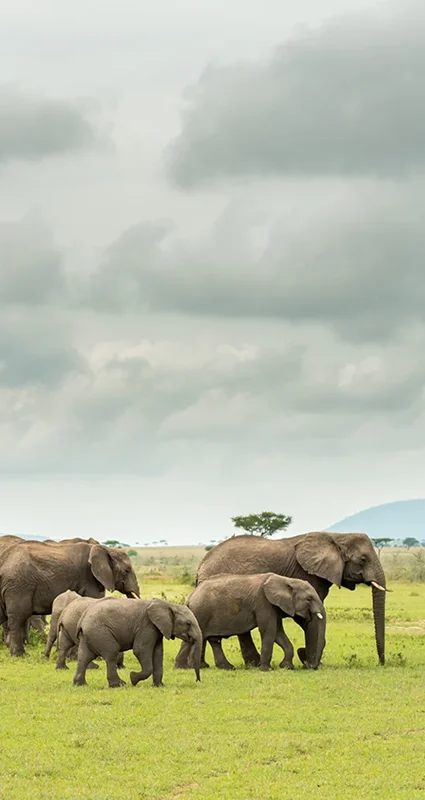
Tarangire National Park covers 2,850 km² in Tanzania's Manyara Region, roughly 100 km south of Arusha, anchored by the perennial Tarangire River - the dry-season magnet that draws the circuit's most extraordinary elephant concentrations. From June to October, herds of up to 300 animals move together toward the riverbed, part of one of Tanzania's densest elephant populations. Ancient baobabs dominate the rolling hills above them, giving Tarangire a visual character unlike anywhere else on the circuit.
The Silale Swamp lions are the park's most distinctive residents, known both for hunting the marshes and for resting in tree branches - almost certainly to escape the tsetse flies active at ground level. In the park's drier woodland margins, gerenuk browse on their hind legs and fringe-eared oryx move through thornbush; both are arid specialists rarely encountered elsewhere in Tanzania. Striped hyenas are present but seldom seen. With more than 500 recorded bird species, including the yellow-collared lovebird and the Tanzania-endemic ashy starling, Tarangire ranks among the country's premier birding destinations. Even at the height of the dry season, it remains quieter and less vehicle-heavy than the Serengeti - a significant part of its appeal for travellers who have done both.
Lake Manyara National Park
Lake Manyara National Park covers just 325 km² where the Great Rift Valley's western escarpment drops sharply toward a shallow alkaline lake - roughly 90 minutes to two hours by car from Arusha - yet it compresses groundwater forest, acacia woodland, floodplain, hot springs and soda lake into one of the most habitat-diverse circuits on the northern route. The lake, fed by underground springs tumbling off the escarpment, occupies two-thirds of the park's area. It forms part of the UNESCO Lake Manyara Biosphere Reserve and connects via the Manyara Ranch wildlife corridor to Tarangire to the south-east.
The park is best known for its tree-climbing lions, which rest in acacia and sausage tree boughs in the southern woodland - most likely to escape tsetse flies or reach cooler air, though researchers have not settled on a definitive explanation. Elephant densities here rank among Tanzania's highest. Manyara is also one of Tanzania's few national parks permitting guided night drives, and its 370-metre Treetop Canopy Walkway - the country's first suspended forest bridge - offers a rare view of the mahogany and fig canopy from above. Flamingo numbers at the lake vary considerably year to year and are never guaranteed on any given visit.
Lake Natron
Lake Natron sits on the floor of the Gregory Rift in northern Tanzania, directly below the active volcano Ol Doinyo Lengai - the Maasai people's sacred Mountain of God. Its alkalinity can exceed pH 12, its shallows reach 60°C, and its surface is stained red and pink by the halophile cyanobacteria and Spirulina algae that thrive in this caustic chemistry. From this hostile environment comes one of Africa's most extraordinary wildlife spectacles: up to 2.5 million lesser flamingos, roughly 75% of the world's population, rely on Natron as East Africa's only regular breeding site, nesting on its evaporite islands between August and October while predators cannot follow them into the caustic water.
The lake sits on Maasai village land rather than within a fenced park, giving visits a quality that most northern circuit destinations cannot replicate. The Engaruka ruins - seven abandoned villages built around an irrigation system that once supported an estimated 5,000 people - lie along the approach route, their origins still unexplained by archaeologists. A hike through the shaded Engare Sero gorge leads to a natural pool beneath palm cliffs. Ol Doinyo Lengai can be climbed overnight with an experienced guide to reach the summit by sunrise, but the ascent is extremely steep, demands genuine fitness and should never be underestimated.
Lake Eyasi
Lake Eyasi lies at the base of a dramatic Rift Valley wall in the Karatu District, roughly 75 km southwest of Ngorongoro, and it is defined not by its wildlife but by its people. The Hadza - estimated at 1,300 to 1,500 individuals - have lived on these shores for at least 50,000 years, making them one of the last true hunter-gatherer peoples in Africa. Their language, Hadzane, is a linguistic isolate: once grouped with the Khoisan languages for its distinctive click sounds, it is now understood to be unrelated to any other tongue spoken on Earth. Hadza men hunt with bows of giraffe tendon and arrows tipped with desert-rose poison; women forage for berries, tubers and wild fruit.
Nearby, the Datoga people are skilled silversmiths, forging tools and jewellery using traditional hand-metalworking techniques passed across generations. Visits to both communities can be arranged through the area's lodges - but the ethics of how such encounters are organised matter as much as the encounter itself. The dawn Hadza hunt is the most sought-after activity here and the most contested; small groups, genuine consent and guides with established community relationships make the difference between a meaningful experience and a staged performance. Between December and June, flamingos and pelicans gather on the lake's shallow waters.
Mount Kilimanjaro
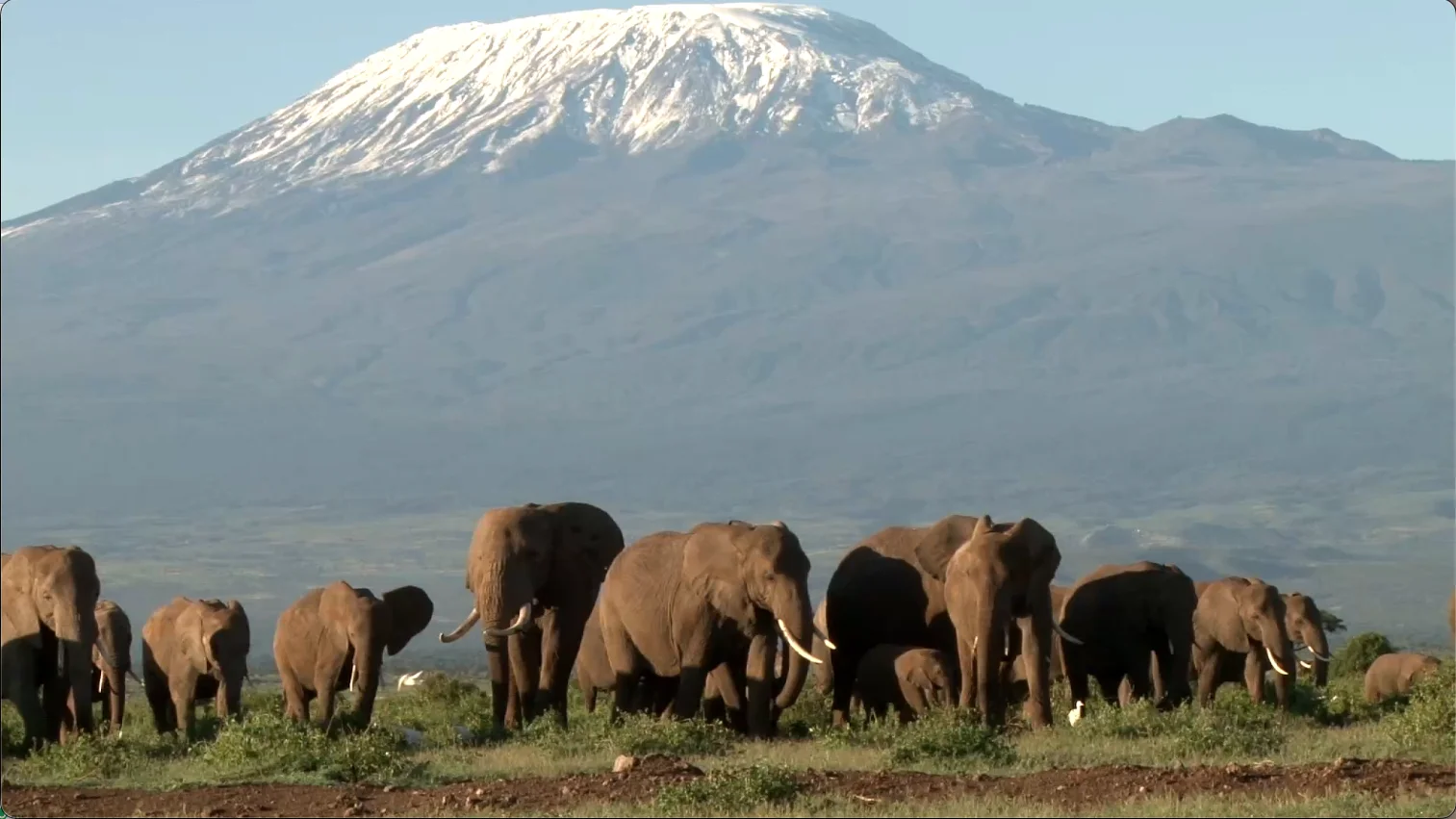
Kilimanjaro announces itself long before you reach its base - a glaciated form floating above the northern Tanzanian savannah, apparently detached from the earth. At 5,895 metres, Uhuru Peak is both Africa's highest point and the world's highest free-standing mountain, a UNESCO World Heritage Site since 1987. The ascent requires no ropes, no crampons and no specialist mountaineering background - only patience, physical commitment and respect for altitude. Five ecological zones unfold from base to summit: from equatorial rainforest through heather moorland to a high-altitude zone of giant groundsels and lobelias, alpine desert and a glaciated summit above the clouds. Seven official routes make the climb differently accessible; the Lemosho and the nine-day Northern Circuit route produce the best summit success rates through gradual altitude gain, with seven to eight days the recommended minimum. The mountain's glaciers - visible from the savannah far below - have retreated significantly due to climate change, a loss that is both measurable and continuing.
Kilimanjaro's pull extends well beyond Uhuru Peak. The private West Kilimanjaro concession (~250 km²) and Sinya concession (~600 km²), both on leased Maasai land, hold some of East Africa's most impressively tusked bull elephants, lesser kudu, gerenuk and striped hyena, with Kilimanjaro's western face rising above the horizon. Game drives, Maasai-led walks and community visits are all possible here without a step toward the summit.
Arusha
Arusha sits at roughly 1,400 metres in the shadow of Mount Meru, where the air is cool and the slopes above rise through coffee estates and forested volcanic terrain. Its reputation as a transit stop undersells it considerably.
Arusha National Park, less than an hour from town, covers 552 km² on Meru's lower slopes and offers something rare in Tanzanian national parks: formally permitted guided walking safaris with an armed ranger, alongside canoe trips across the alkaline Momela Lakes, mountain biking, game drives and a half-day Meru Crater hike. Mount Meru rises to 4,566 metres and is reached by a three-to-four-day guided ascent through forest, moorland and volcanic terrain with far fewer trekkers than Kilimanjaro. In the city, the Cultural Heritage Centre holds one of East Africa's largest art collections; Sidai Designs channels Maasai women's beadwork into contemporary jewellery with workshops open to visitors; and the Shanga workshop at Elewana Arusha Coffee Lodge employs artisans with disabilities. International arrivals use Kilimanjaro International Airport (JRO), about an hour away; charter flights and domestic connections depart from Arusha Airport (ARK), about 20 minutes from the city centre.
Trusted by thousands of ecstatic travellers
✔️ 5-Star Trustpilot Rating ✔️ Condé Nast Travel Specialist Award Winner
✔️ Accredited by SATSA ✔️ 5,000+ Exceptional Safaris Since 1991
Why choose Africa Geographic to plan your safari?

"...Koroi Forest Lodge in Arusha National Park Tanzania for Colobus & Blue monkeys plus amazing birds, Olmara Camp in the eastern Serengeti and Esirai Mobile Camp in the northern Serengeti for big and small cats and so much more, then rounding it out with Mbali Mbali at Gombe National Park for 4 days trekking with Chimpanzees in the footsteps of Jane Goodall's research...We highly recommend...AG"
"The safari itself was extraordinary. Each place we stayed had its own atmosphere and purpose, and the flow of the trip was perfect: Kilimanjaro, Tarangire, Lake Manyara, Ngorongoro, Olduvai, Ndutu, and the Serengeti. We had so many highlights...We would recommend Africa Geographic without hesitation to anyone looking for a safari that is personal, well‑designed, and truly special."
"I recently returned from a safari in Tanzania ,I am an 65 year female traveling solo and it was an unforgettable experience. I booked through...Africa Geographic, who took the time to understand my needs and expectations, then tailor-made the entire trip accordingly. Everything ran seamlessly. The guides were deeply in tune with their environment...I’ve already booked another trip..."
Wish you were here?
Frequently asked questions
A collection of protected areas surrounding Arusha, most commonly combining Serengeti, Ngorongoro, Tarangire and Lake Manyara - with Grumeti, Loliondo, Lake Natron, Lake Eyasi and Kilimanjaro as compelling additions. All are reachable by road or charter flight.
Allow a minimum of 10 to 14 days for the four main parks. Adding Kilimanjaro, Lake Natron or Lake Eyasi extends the trip to three weeks or more.
June to October is the main dry season, ideal for wildlife viewing and the Mara River crossings. January to March offers calving season on the southern Serengeti plains with fewer visitors.
Fly into Kilimanjaro International Airport (JRO), roughly one hour from Arusha. Arusha Airport (ARK) handles domestic and charter connections to Serengeti airstrips, approximately 1.5 hours by light aircraft.
Yes - lions, leopards, elephants, buffalo and black rhinos are all present. Ngorongoro Crater offers the most reliable single-day access to all five; eastern black rhinos were also reintroduced to Grumeti Game Reserve in 2019.
Between 1.4 and 2.5 million wildebeest and zebra move year-round through the Serengeti–Mara ecosystem. Grumeti River crossings occur in June–July; Mara River crossings from August to mid-October; calving peaks in February on the southern Ndutu plains.
Yes - it is the circuit's most popular pairing amongst our guests, linked by road or light aircraft. January to March suits the calving season at Ndutu, combined with a crater descent; June to October suits the dry-season Serengeti.
As a private concession rather than a national park, Grumeti permits off-road driving, night drives and hot-air ballooning. Its handful of Singita lodges share 140,000 hectares, guaranteeing uncrowded wildlife encounters.
Yes. The wider Conservation Area includes Oldupai Gorge, the Olmoti and Empakai craters (both walkable), and Lake Ndutu, where the Great Migration calves each January to March.
A caustic Rift Valley soda lake below the active volcano Ol Doinyo Lengai - and East Africa's only regular breeding site for lesser flamingos, with up to 2.5 million birds. Remote and elemental; a deliberate detour for the right traveller.
The Hadza are one of Africa's last hunter-gatherer peoples, living around Lake Eyasi for at least 50,000 years. Visits can be arranged through local lodges; small groups, genuine consent and guides with real community ties are essential.
No. The West Kilimanjaro and Sinya concessions offer game drives and Maasai-led walks in the mountain's shadow, with large-tusked elephants, lesser kudu and gerenuk - no climbing required.
Malaria is present throughout Tanzania; antimalarial medication is strongly recommended. A yellow fever certificate is only required if entering from a yellow fever country. Comprehensive travel and medical evacuation insurance is essential.
Our safaris typically cost from US$700 per person, per night, depending on the accommodation comfort level, time of year and activities. This price usually includes accommodation, all meals, game drives, experienced guides, airport transfers, and 24/7 support from our team.
Click here to schedule a no-obligation call with one of our Safari Experts or fill in our 2-minute form with your questions. Our team of experts are here to help! Whether you’re curious about the best time to travel, want to hear first-hand about an experience or need help planning your safari.
Explore more African destinations
Start planning your dream safari
Our travel experts will craft a no-obligation itinerary just for you. We have crafted over 5,000 safaris since 1991. Your personal details are protected; we only use this information to contact you.
Why book your safari with us?

Deep Experience & Knowledge
Handcrafted experiential safaris since 1991.
Travel in Africa is about knowing when and where to go, and with whom. A few weeks too early/late or a few kilometres off course, and you could miss the greatest show on Earth. And wouldn’t that be a pity?

Trust & Safety

Make A Difference
We donate a portion of the revenue from every safari sold to carefully selected conservation projects that make a significant difference at ground level.
YOUR safari choice does make a difference - thank you!