

Safari experts & storytellers. Since 1991



Pilanesberg National Park: Malaria-free Big 5 safaris near Johannesburg
Pilanesberg National Park at a glance
Location: North West Province, South Africa - approximately 200 km from Johannesburg | Access: Pilanesberg International Airport (within the park); OR Tambo International Airport, Johannesburg (~220 km) |
Size: 550 km² - the fourth-largest national park in South Africa | Best time to visit: May–September (dry season, peak wildlife viewing); October–March (green season, excellent birding and newborn animals) |
Malaria risk: None - Pilanesberg is malaria-free year-round | Minimum recommended stay: 2–3 nights; day trips from Johannesburg are possible |
Currency: South African Rand (ZAR) | Management: North West Parks and Tourism Board (SANParks Wild Cards are not valid at Pilanesberg) |
Why visit Pilanesberg National Park?
Few safari destinations in southern Africa offer what Pilanesberg does: all five of Africa's Big 5 species - lion, leopard, elephant, buffalo and rhinoceros - in a completely malaria-free environment. For international travellers, families with children, or anyone concerned about antimalarial medication, that combination changes the calculus of an African safari entirely.
The park sits within the eroded volcano crater of an ancient alkaline ring complex - a geological formation so rare that only a handful of comparable structures exist anywhere on Earth. That volcanic architecture shapes everything: the concentric ridges and valleys, the rocky outcrops above open plains, and the waterholes that draw wildlife from across the reserve. Pilanesberg also occupies a unique ecological position at the boundary of the dry Kalahari to the west and the moister Lowveld to the east, producing a biodiversity where species from both systems share the same terrain.
Set roughly two hours from Johannesburg, with an airport within the park boundary and over 200 kilometres of roads open to self-drivers, Pilanesberg makes meaningful access to African bushveld possible in a way few reserves can match. With more than 7,000 animals, a conservation story that rewrote the science of wildlife translocation, and one of the most unusual landscapes in southern Africa, there is more here than the location alone suggests.
5 reasons we love Pilanesberg National Park
The malaria-free Big 5: All five iconic species with no malaria risk - Pilanesberg opens Africa's greatest wildlife encounters to every traveller, regardless of age or health considerations.
A landscape born from fire: The roots of a 1.3-billion-year-old volcano form concentric ridges and ancient hills found almost nowhere else on Earth.
Where two biomes meet: On the boundary of the Kalahari and the Lowveld, 15 antelope species and more than 350 birds share the same 550 km² reserve.
A conservation story worth knowing: Operation Genesis returned over 6,000 animals to exhausted farmland in 1979, and the lessons didn't stop there.
Safari without the complications: Malaria-free, self-drive-friendly, and two hours from Johannesburg, open 365 days a year.
All you need to know about Pilanesberg
About Pilanesberg National Park
Pilanesberg National Park occupies the eroded volcanic crater of an ancient alkaline ring complex in South Africa's North West Province. Roughly 24 kilometres across, this formation is one of only a handful of comparable geological structures on Earth, with concentric rings of erosion-resistant rock defining the hills that frame every drive through the reserve. At 550 km², Pilanesberg is South Africa's fourth-largest national park.
The park's ecology is shaped by a rare convergence: dry Kalahari Thornveld to the west meets moister Lowveld to the east, creating a distinct vegetation type - Pilanesberg Mountain Bushveld - that supports species from both biomes in the same landscape. Mankwe Dam, the park's largest body of water, is its most productive wildlife-watching focus, drawing animals and birds from across the reserve. More than 200 kilometres of roads, open to any vehicle, make Pilanesberg one of the few major South African reserves where a self-drive safari is a deeply satisfying way to explore.
Things to do in Pilanesberg National Park
Game drives: Dawn and dusk departures in open safari vehicles, guided by experienced rangers, put guests among predators at peak activity, with the low light making every sighting count.
Self-drive safaris: A self-drive safari is well served by 200 km of tarred and dirt roads, open to any vehicle, with lookout points over waterholes and open plains.
Hot air ballooning: A sunrise flight over the volcanic landscape reveals the ring complex's concentric structure from above - a perspective on the park impossible to find from the ground.
Walking safaris: Expert-guided bush walks slow the pace, uncovering tracks, plants, and sounds that game drives pass without notice - a more intimate encounter with the wild.
Photographic hides: Concealed hides at waterholes across the park give close, undisturbed access to wildlife and birds - at ground level, without a vehicle present.
Birding: More than 350 species; Mankwe Dam is particularly productive for African fish eagle, kingfishers and waterbirds. Summer months bring migrants and peak activity.
What wildlife can I see in Pilanesberg?
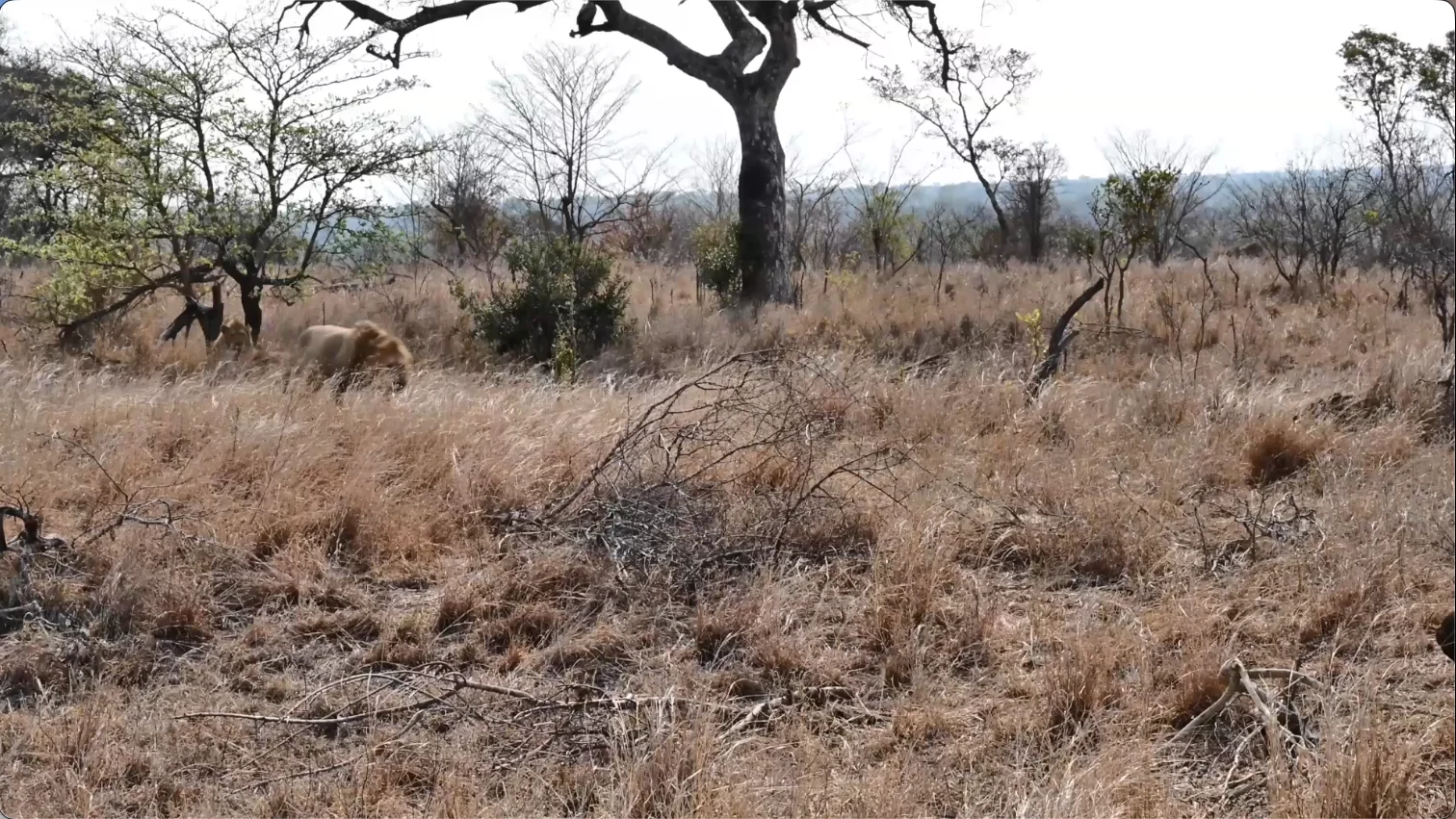
The Big 5: Lion, leopard, elephant, buffalo and rhinoceros are all resident, including both white and black rhino. Elephant and white rhino sightings are among the most frequent.
African wild dog (painted wolf): One of Africa's most endangered social predators; Pilanesberg is a confirmed sighting location and one of the better reserves in South Africa to encounter them.
Predator diversity: Cheetah, brown hyena, caracal, serval, bat-eared fox and the nocturnal aardwolf complete a predator community of remarkable depth and variety.
Antelope richness: Fifteen species confirmed, from sable, roan and tsessebe to gemsbok, greater kudu and waterbuck - a direct result of the park's two-biome overlap.
Hippo and crocodiles are drawn to Mankwe Dam - the park's busiest waterside haunt.
Birdlife: More than 350 species occur, including Cape vulture, secretarybird, kori bustard, southern pied-babbler, great sparrow, crimson-breasted shrike (including the rare yellow morph), short-toed rock-thrush, coqui francolin, violet-eared and black-faced waxbills and Kalahari scrub-robin.
Black Rhino Game Reserve
Black Rhino Game Reserve is a 2,000-hectare private reserve adjoining the national park's northwest boundary. No fences separate Black Rhino from the national park; wildlife moves freely across both, and lodge vehicles have full traversing rights into Pilanesberg. Guests staying within Black Rhino have access to both the intimacy of a private reserve and the breadth of the national park.
The reserve's sweetveld vegetation contrasts with the Pilanesberg's predominantly mixed sour veld, and its lower-lying terrain supports strong Big 5 viewing - white and black rhino, elephant, buffalo, lion and leopard. African wild dog (painted wolf) and various rare antelope species are also present, alongside more than 350 bird species. Black Rhino operates its own secured private entrance on the western boundary, distinct from the main park gates and offering a quieter, more exclusive approach into the reserve for guests staying within it.
Where to stay in Pilanesberg National Park
Inside Black Rhino Game Reserve:
Tambuti Lodge is the most intimate choice nestled in a grove of tamboti trees: five suites, each with its own private viewing deck, evening meals in a fire-lit boma or beneath open skies. For those seeking something more architecturally ambitious, Tambuti offers contemporary elegance.
Lush Private Lodge is an ultra-exclusive eight-suite boutique safari lodge tucked into a quiet, wooded hillside. The open-plan, multi-tiered main lodge connects indoor and outdoor living spaces, featuring open-air lounge decks, fire pits, shaded dining areas, a wine cellar and a glass-fronted fitness centre and wellness spa.
Inside Pilanesberg National Park:
Tshukudu Bush Lodge offers a traditional thatched lodge centred around an expansive wooden viewing deck with panoramic views across the plain, an intimate rock plunge pool, and an open boma area for dining under the stars.
Shepherd's Tree Game Lodge enjoys sweeping panoramic views across the Pilanesberg bushveld and the dramatic amphitheatre of the ancient volcanic hills - one of the park's finest vantage points. A spa and elegant suites make it particularly well suited to those seeking a full-service lodge experience, with that extraordinary landscape as a constant presence throughout the stay.
The history of Pilanesberg National Park
The ground beneath Pilanesberg is older than almost anything around it. Approximately 1.3 billion years ago, molten rock pushed through the earth's crust here and built a volcano that may have stood 7,000 metres high. What survives is an alkaline ring complex - those concentric ridges are the ancient roots of that structure, slowly shaped by erosion over an almost incomprehensible span of time.
People have lived in this landscape for a very long time. Iron Age settlement sites lie within the current park boundary, and by the nineteenth century the surrounding land was home to Tswana-speaking communities, principally the Bakgatla-ba-Kgafela and the Bakubung ba Ratheo. The park takes its name from Kgosi Pilane, the Bakgatla chief. Their descendants' names remain on the gates today: Bakubung, Bakgatla, Manyane - a continuity that runs through the land's long human history into the present.
By the 1970s, the land had been reduced to worn-out cattle and crop farming. What changed it was politics. Bophuthatswana had been declared nominally independent in 1977, one of the apartheid state's ethnic homelands, recognised by no other country. That nominal sovereignty created legal conditions unavailable elsewhere in South Africa, and Sun City opened in 1979 as a direct consequence. A wildlife reserve next door made both commercial and political sense.
In 1979, the Bophuthatswana government launched Operation Genesis. Farms were consolidated, internal fencing removed, and approximately 6,000 animals moved in - one of the most ambitious wildlife translocation projects attempted anywhere at that point. Species absent for a century returned. The park worked, and Pilanesberg became a genuine conservation success story.
It was also a success built on removal. Creating the park required clearing the land of the communities farming it, under a government whose authority derived from the homeland system itself. Those histories resurfaced after 1994, when Bophuthatswana was reincorporated into South Africa, and land claims were lodged across the region. The park is now administered by the North West Parks and Tourism Board.
One later chapter deserves particular attention because it changed how conservation professionals think. Orphaned young elephants - survivors of Kruger National Park's then culling programme - were relocated to Pilanesberg through the 1980s and early 1990s. Growing up without adult bulls, some entered musth years ahead of the normal age and sustained it for months. In the mid-1990s, they began killing white rhino: around forty animals died. The resolution came in 1998, when six mature bulls were introduced from Kruger. Their presence suppressed the young males' musth, and the killings stopped. It remains one of the clearest field demonstrations that elephant society depends on older animals to regulate the young - a lesson learned here, at direct cost, as a consequence of decisions made elsewhere.
Trusted by thousands of ecstatic travellers
✔️ 5-Star Trustpilot Rating ✔️ Condé Nast Travel Specialist Award Winner
✔️ Accredited by SATSA ✔️ 5,000+ Exceptional Safaris Since 1991
Why choose Africa Geographic to plan your safari?

"We have been using Africa Geographic a few times in the past and they have never let us down...and provides expert advice on any question one might have. Our recent trip to South Africa was a small group taking us to Pilanesberg...Everything worked like clockwork, from airport transfers to accommodation to providing information. I would always trust AG...to deliver the best experience possible..."

"As a bucket list trip this did not disappoint. Africa Geographic staff planned an amazing South African adventure to help me see as many small mammal species as were willing to show themselves during my visit...made suggestions and tweaks until they both felt the trip would meet my dreams, and they weren't wrong...A trip I will never forget, with a company I would highly recommend."

"A top company to help organise and arrange your perfect safari trip...extremely helpful in tailoring our experience exactly how we wanted it, from the initial conversations, to suggested changes, to the organisation whilst on the trip. I would throroughly reccomend Africa Geographic...Will definitely be recommending them and using them again if and when we visit Africa!"
Wish you were here?
Frequently asked questions
Yes. Pilanesberg is entirely malaria-free. The park's highveld altitude, dry winters and lower rainfall create conditions in which malaria-carrying mosquitoes cannot establish. No antimalarial prophylaxis is required for a visit.
All five Big 5 species - lion, leopard, elephant, buffalo and rhinoceros - are resident in the park. Both white and black rhinos occur within the greater Pilanesberg area, and elephants and white rhinos are among the most frequently encountered.
Pilanesberg is approximately 200 km from Johannesburg - around two and a half hours by road. OR Tambo International Airport is roughly 220 km from the park.
May to September, the dry winter season, offers the best wildlife viewing: sparse vegetation, animals concentrated at waterholes, and clear cool days. October to March brings summer rains, lush landscapes, strong birding and many newborn animals. April is a quieter transitional month with good photographic conditions.
Yes. The park has over 200 kilometres of tarred and dirt roads, accessible to any vehicle type. Multiple waterhole look-out points are positioned across the reserve, and the compact layout makes self-drive wildlife viewing both practical and rewarding.
Day trips from Johannesburg are possible, but two to three nights gives sufficient time to explore the park properly across multiple drives at different times of day. Those staying in Black Rhino Game Reserve may find three to four nights more satisfying.
Black Rhino Game Reserve is a 2,000-hectare private reserve on the northwest boundary of Pilanesberg National Park. There are no fences between the two areas - wildlife moves freely across both - and lodge vehicles within Black Rhino hold full traversing rights into the national park.
No. Pilanesberg is managed by the North West Parks and Tourism Board, not SANParks. The SANParks Wild Card is not valid at the park's gates - entrance is paid separately on arrival.
Pilanesberg International Airport is located within the park boundary and handles domestic flights, including scheduled services from Cape Town. International travellers arrive via OR Tambo International Airport in Johannesburg, approximately 220 km away.
Pilanesberg supports more than 350 bird species. Mankwe Dam is one of the park's most productive birding locations, with African fish eagle, malachite kingfisher and various waterbirds reliably present. Summer brings migrants and peak breeding activity, and photographic hides provide excellent year-round access.
Both reserves offer the Big 5 in South Africa, but for different needs. Pilanesberg is malaria-free, considerably smaller and within easy reach of Johannesburg. Kruger offers a greater sense of wilderness and scale. Many travellers include both parks on a single South African itinerary.
Sun City Resort is adjacent to Pilanesberg and is historically linked to the park - both developed during the same period in the former homeland of Bophuthatswana. Many travellers combine a Pilanesberg safari with time at Sun City's casino, golf courses and water park.
Operation Genesis was the 1979 wildlife translocation project that established Pilanesberg as a functioning reserve. Approximately 6,000 animals were introduced from across southern Africa, with careful attention to gene pool quality and environmental suitability. It was one of the most ambitious projects of its kind at the time, and the park's wildlife population today is its direct result.
Pilanesberg safaris in fully catered lodges typically cost from R4,230 per person, per night, depending on the accommodation comfort level, time of year and activities. This price usually includes accommodation, all meals, game drives, experienced guides, and 24/7 support from our team.
Click here to schedule a no-obligation call with one of our Safari Experts or fill in our 2-minute form with your questions. Our team of experts are here to help! Whether you’re curious about the best time to travel, want to hear first-hand about an experience or need help planning your safari.
Explore more African destinations
Start planning your dream safari
Our travel experts will craft a no-obligation itinerary just for you. We have crafted over 5,000 safaris since 1991. Your personal details are protected; we only use this information to contact you.
Why book your safari with us?

Deep Experience & Knowledge
Handcrafted experiential safaris since 1991.
Travel in Africa is about knowing when and where to go, and with whom. A few weeks too early/late or a few kilometres off course, and you could miss the greatest show on Earth. And wouldn’t that be a pity?

Trust & Safety

Make A Difference
We donate a portion of the revenue from every safari sold to carefully selected conservation projects that make a significant difference at ground level.
YOUR safari choice does make a difference - thank you!